Software & engineering for nonlinear structural dynamics

Nonlinear vibration. Precisely computed.
Clearly understood.

With the OrAgL solver, you compute how friction and contact shape the vibration behaviour of your structure. With ARGUS, input, runs and results stay in one workflow. Backed by engineering that comes straight from research.

Harmonic balanceTime domainFrictional contactCyclic symmetryHPC clusters

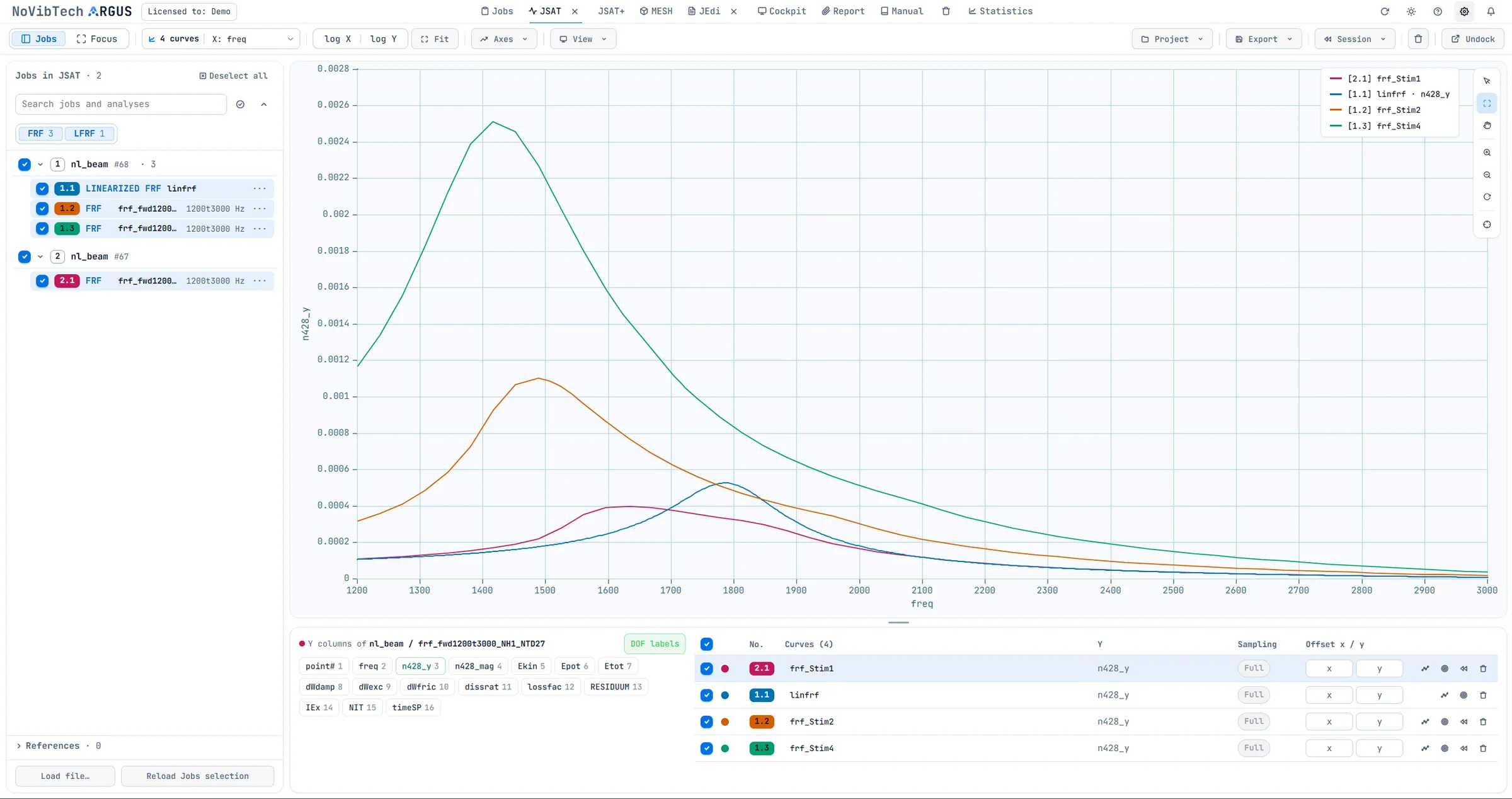
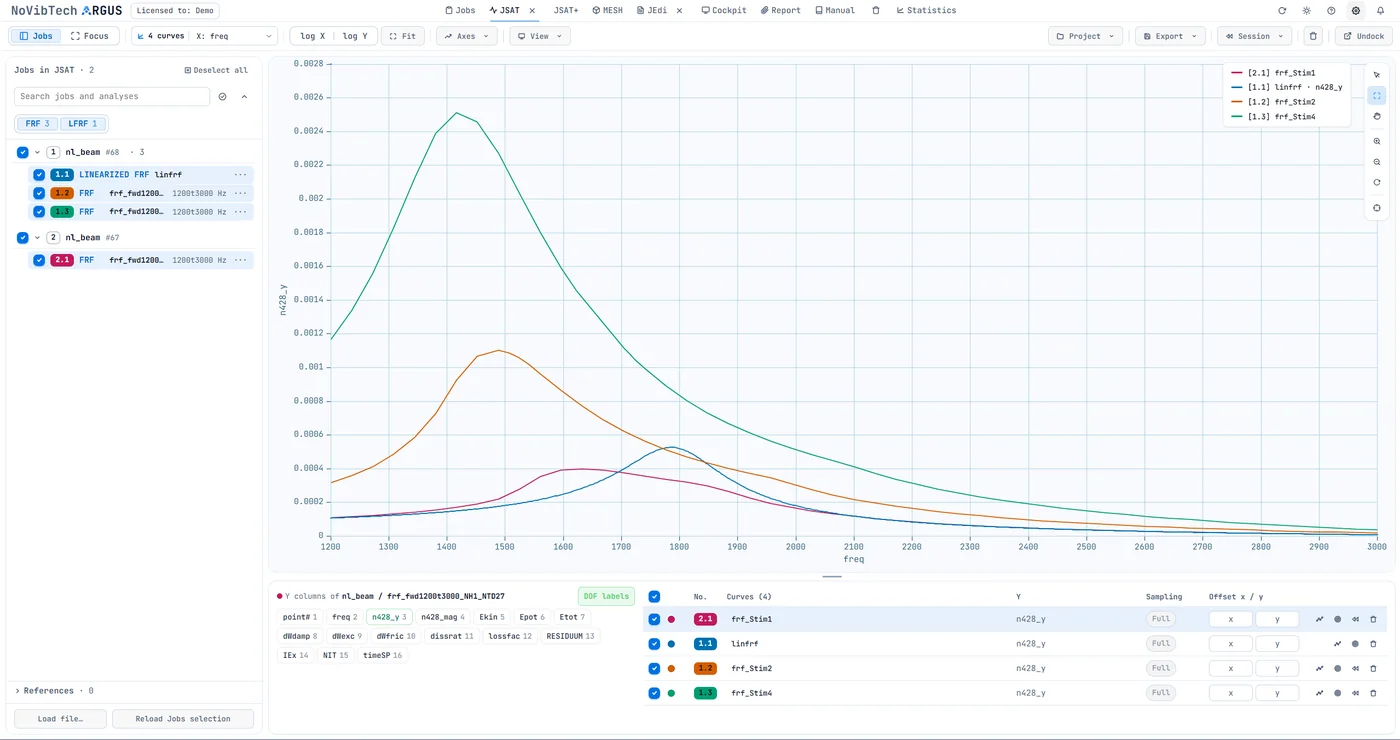
ARGUS · JSATCompare curves live
ARGUS JSAT: several frequency responses computed with OrAgL, compared side by side
OrAgL · frequency response, schematic Contact stiffens, the response jumps

Development partners & customers

Institute of Aircraft Propulsion Systems

University of Stuttgart · development partner

Aerospace · Energy · Automotive

Industrial customers

Two products, one workflow

The physics in the solver. The overview in ARGUS.

OrAgL solves the nonlinear equations of motion. ARGUS turns them into a traceable workflow. Together with our engineering, the result is a sound answer to your question.

Solver

OrAgL

The specialised solver for structures whose vibration behaviour depends on friction, contact and amplitude, such as blades with coupling interfaces and friction dampers.

  • Harmonic balance *HBM
  • Nonlinear frequency response *FRF
  • Frictional contact with preload
  • Nonlinear modal analysis *NMA
  • Model reduction (Craig-Bampton)
  • Time-domain analysis *NOSTIA
Engineering interface

ARGUS

Search less, understand more. ARGUS connects input, computation and results, from the first keyword to the final animation.

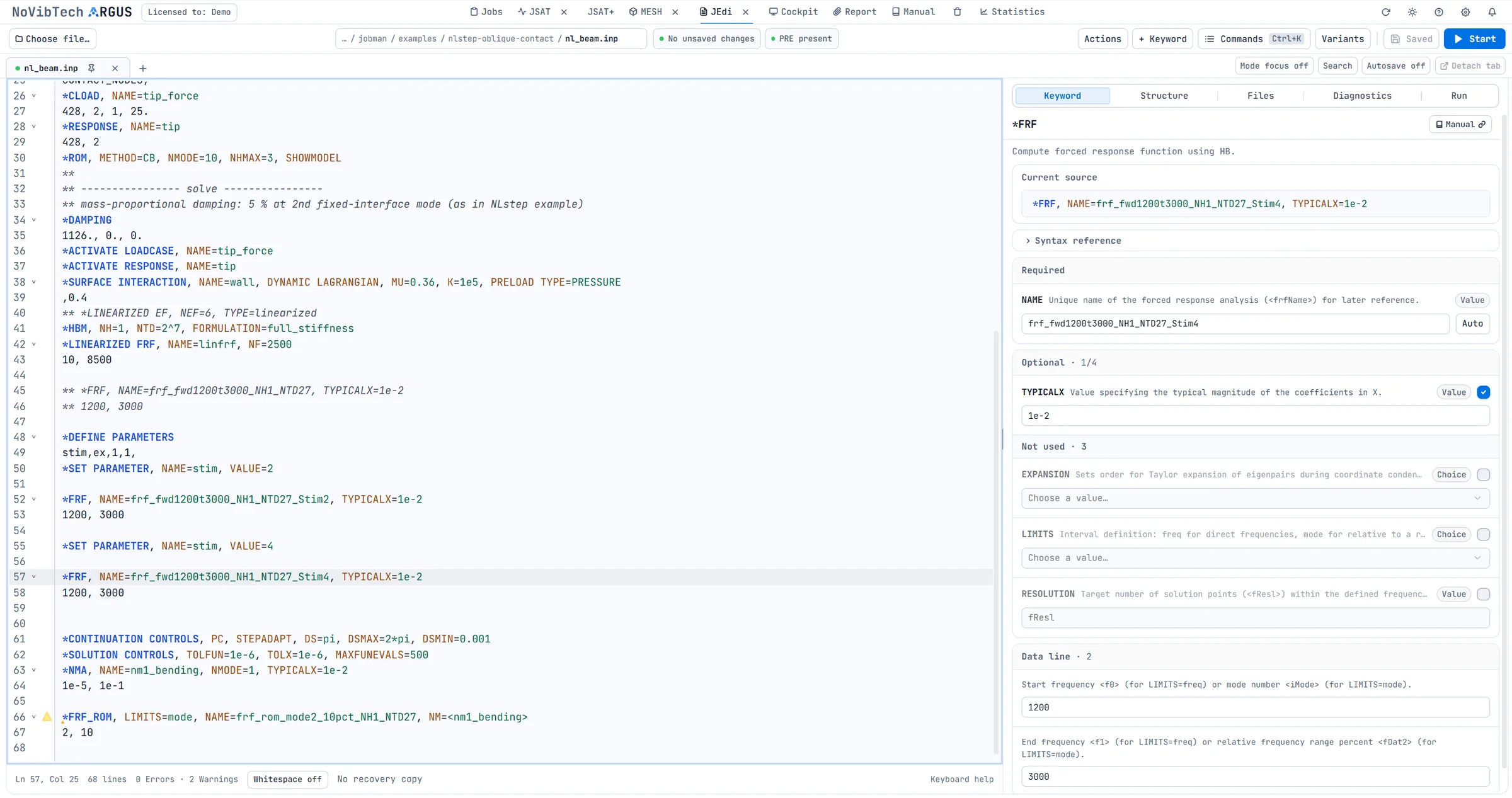
  • JEdi · deck editor with keyword help
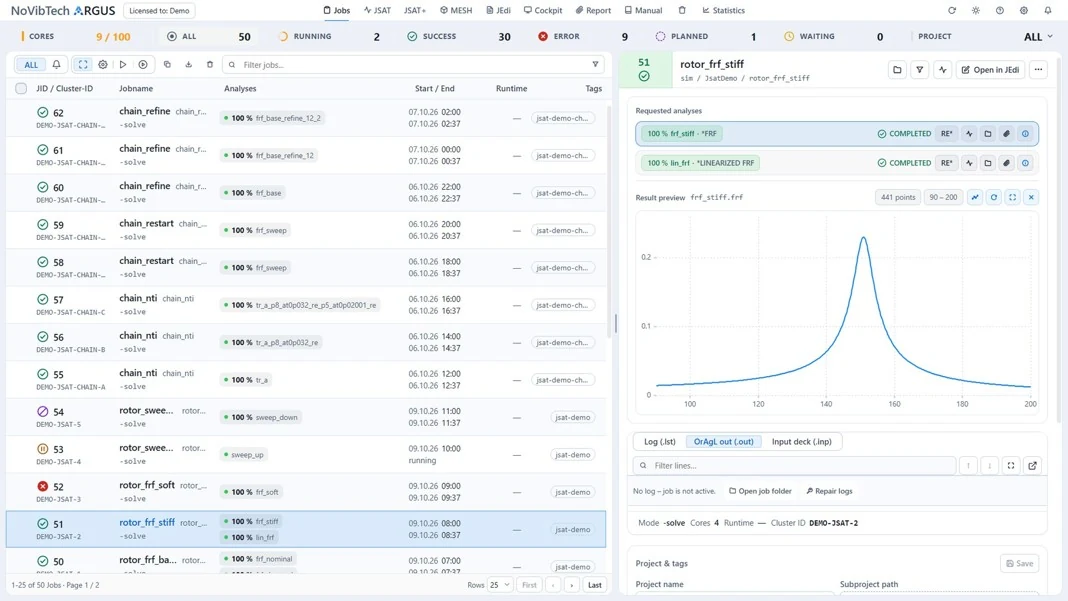
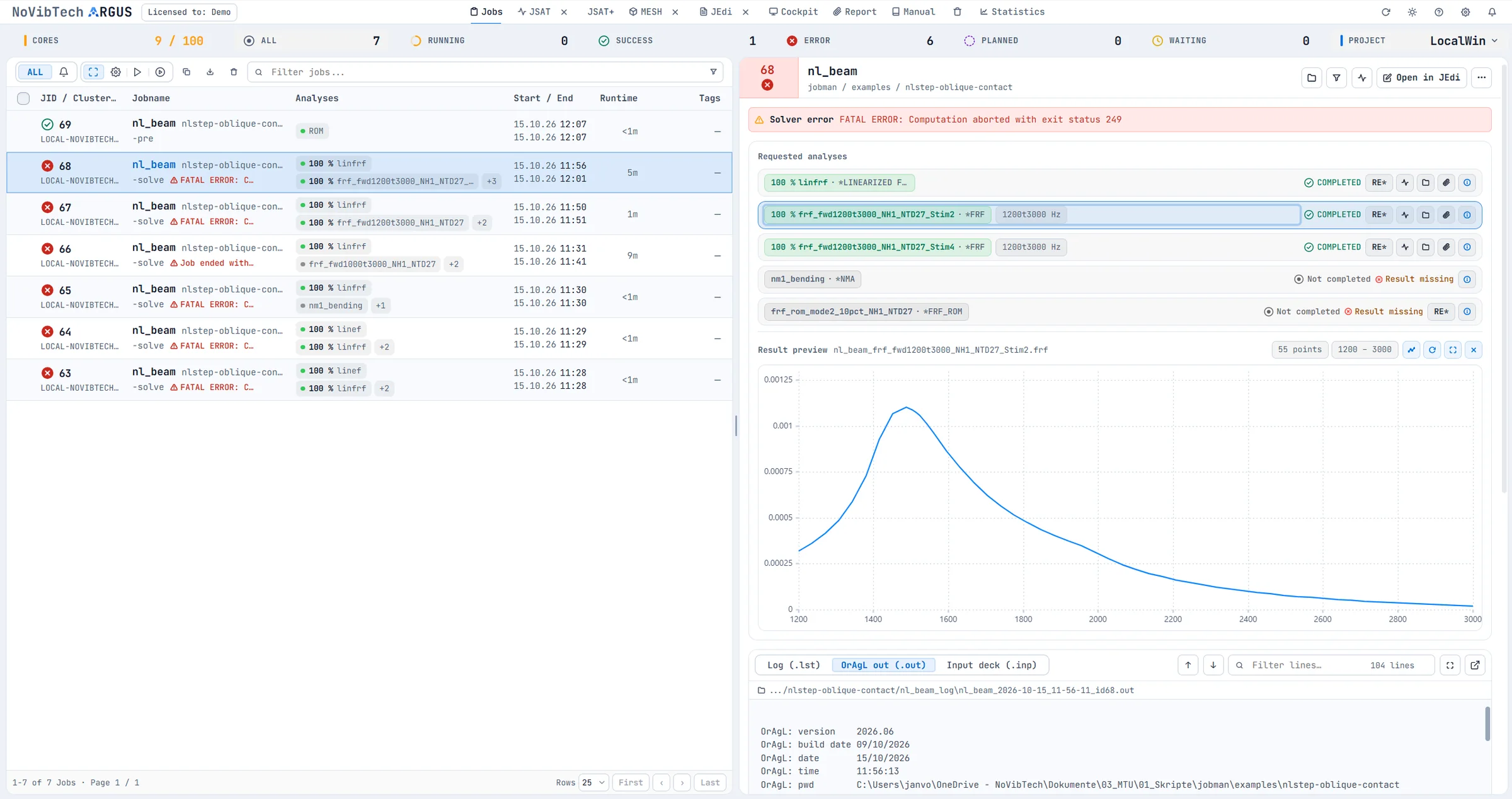
  • Jobs · status, logs, resources
  • JSAT · compare curves live
  • RE* · restart from a curve point
  • MESH · model and mode shapes
  • Built for HPC clusters, e.g. PBS
ARGUS Jobs: list of runs with analyses and a frequency response preview
2018

technology transfer from the University of Stuttgart, NoVibTech GmbH since 2026

24

publications on the methods

3

fields of application: turbomachinery, gearboxes, bolted joints

5

ARGUS modules for an end-to-end OrAgL workflow

ARGUS in detail

From the first keyword to the final animation.

Five modules, one workflow. Click through actual views from the ARGUS product preview.

All features
ARGUS JEdi: OrAgL deck on the left and keyword inspector with parameter guidance on the right. Enlarge ↗
JEdi · Every keyword explained, right in the deck. Inspector, catalogue, autocomplete and the matching manual entry. Diagnostics and PRE status show whether a run is ready before you submit it.
ARGUS Jobs: job list, analysis progress, result preview and log in one view. Enlarge ↗
Jobs · Every run at a glance. Status and progress per requested analysis, a quick result preview, .lst, .out and deck in one panel. Errors surface immediately instead of hiding in a log file.
ARGUS JSAT: several frequency response curves with a legend and result selection. Enlarge ↗
JSAT · The curve grows while the solver runs. Plot results from several runs together with reference curves, with offsets and a legend, and pick degrees of freedom precisely by DOF label.
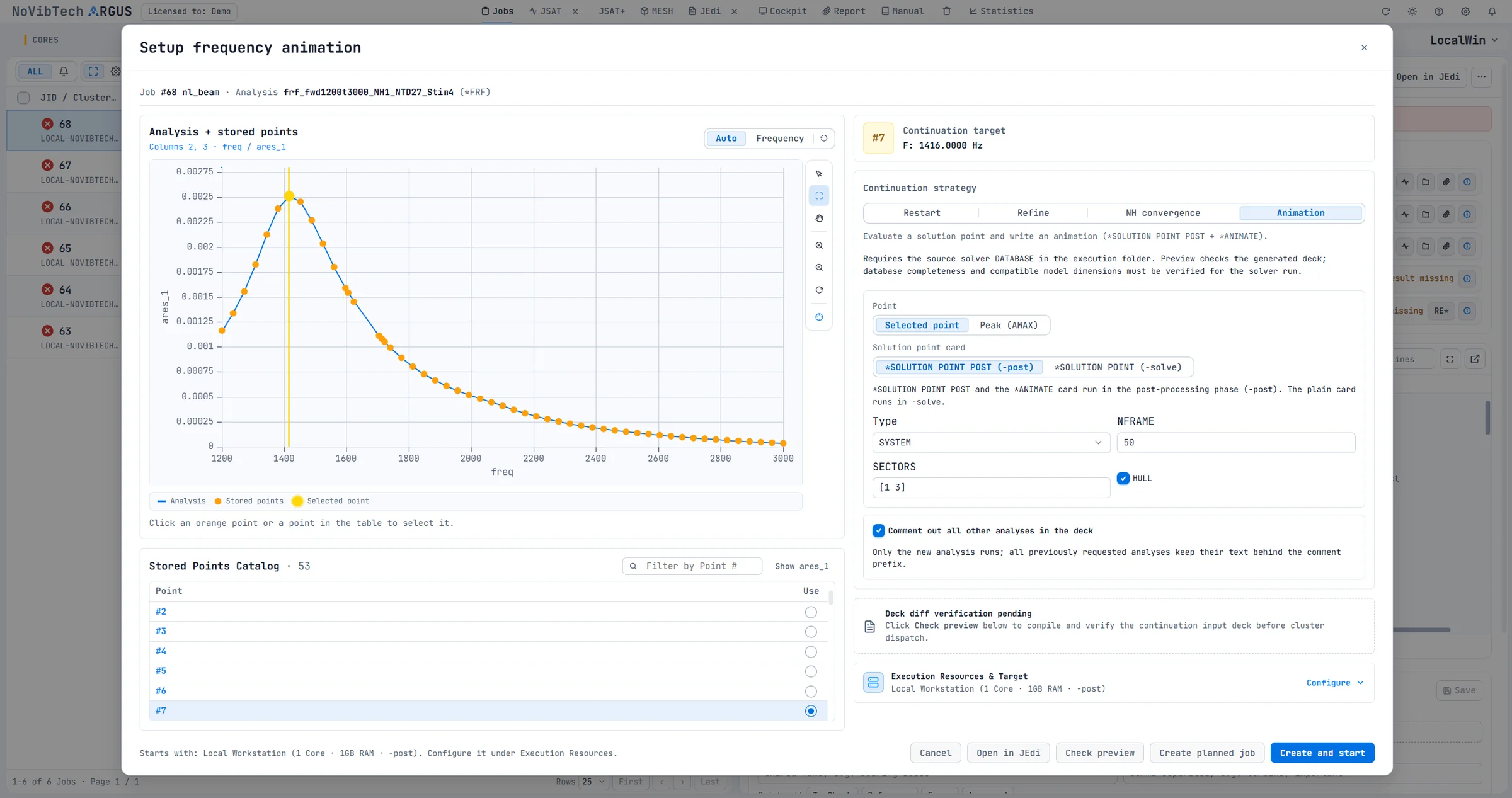
ARGUS restart dialog: a stored curve point and continuation strategy. Enlarge ↗
RE* · Pick a point on the curve, choose a strategy (continue, cross-analysis or animation) and review the changed deck in a diff preview. Frequency and state come from the data set, not from copying values by hand.
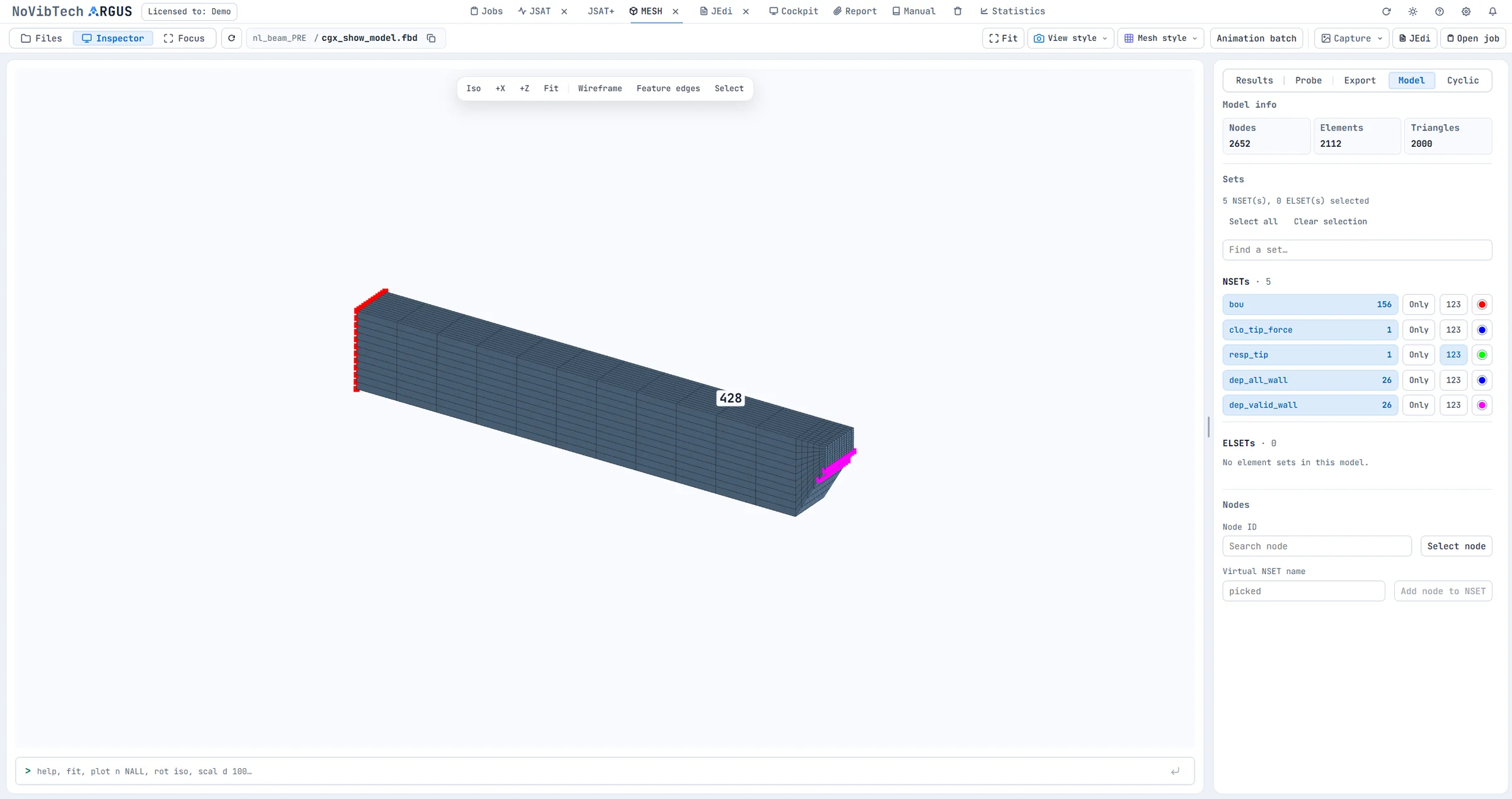
ARGUS MESH: an FE model with coloured node sets and model information. Enlarge ↗
MESH · Contacts, loads and response nodes coloured in the model. For cyclic symmetry, go from one sector to the full wheel: add sectors, play mode shapes back and export them.

Applications

When friction and contact govern the dynamics.

As soon as joints stick, slip or separate, a linear model is no longer enough. The resonance shifts and damping depends on amplitude. This is exactly where OrAgL and our engineering come in.

01

Turbomachinery

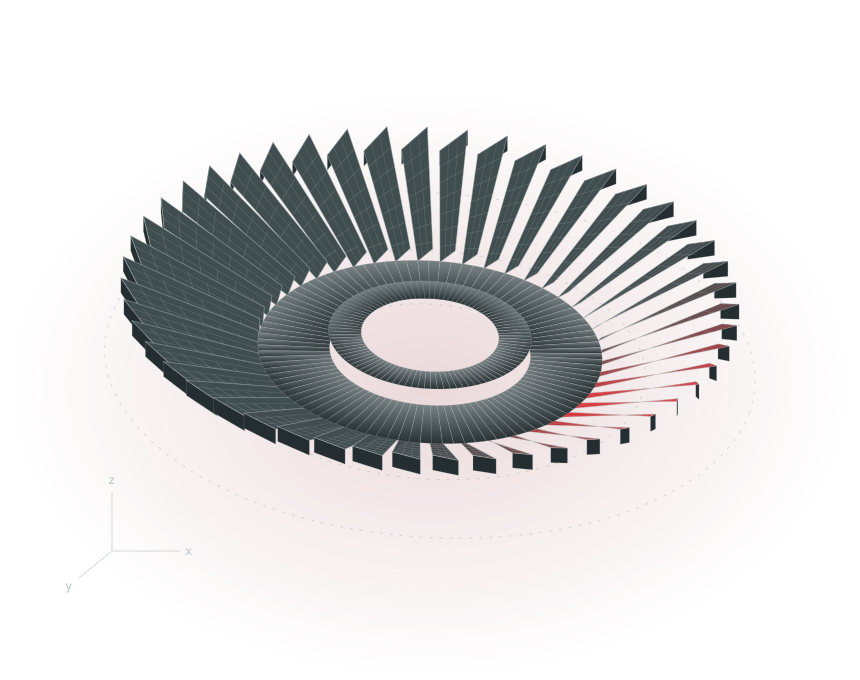
Friction dampers, shroud and root contacts: nonlinear frequency responses and animated mode shapes, from a sector to the full wheel.

02

Gearboxes

Tooth contact with backlash: lift-off, impacts and jumps in the vibration response.

03

Bolted joints

Micro-slip in the interface governs the stiffness and damping of jointed structures.

04

Frequency & time domain

Harmonic balance for periodic responses, time integration for transients, sweeps and impacts.

Published validation

Measured on the rig and in the engine.

In a peer-reviewed study, nonlinear vibration responses computed with OrAgL were compared with measurements on a rotating test rig and in the engine.

Rig and Engine Validation of the Nonlinear Forced Response Analysis Performed by the Tool OrAgL

Hartung, Hackenberg, Krack, Gross, Heinze, Panning-von Scheidt · Journal of Engineering for Gas Turbines and Power 141(2), 2019

Engineering

Your question. Our expertise in methods.

Not every task starts with a licence. We run analyses, develop contact models and methods, and help your team put them into practice.

How we work
01

Define the question

Which decision should the analysis support? Agree on component, contacts and target quantities.

02

Build the model

Reduce the FE model and choose the contact model and nonlinearities that fit the physics.

03

Compute & vary

Run OrAgL, follow it in ARGUS and vary the parameters that matter.

04

Assess & hand over

Explain results and their limits, and hand over report and data in a traceable way.

Research

Methods you can look up.

Harmonic balance, frictional contact, model reduction: 23 journal and conference papers and a Springer book document the foundations. Many were produced together with industry and validated on test rigs.