
Harmonic balance
Periodic vibration responses computed efficiently in the frequency domain, with a selectable number of harmonics.
*HBMNonlinear structural dynamics
OrAgL is the specialised solver for structures whose vibration behaviour depends on friction, contact and amplitude. It computes periodic responses in the frequency domain and transient behaviour in the time domain, including for large, reduced FE models.
Capabilities
Focused on the physics that linear models miss: amplitude-dependent stiffness and damping caused by friction and contact, in the frequency and the time domain.
Periodic vibration responses computed efficiently in the frequency domain, with a selectable number of harmonics.
*HBMForced responses across a frequency range, with a linearised reference for direct comparison.
*FRF · *LINEARIZED FRFAmplitude-dependent natural frequencies and damping as a compact description of system behaviour.
*NMAStick, slip and lift-off at coupling interfaces, with friction coefficient, contact stiffness and preload.
*SURFACE INTERACTIONReduce large FE models to the relevant degrees of freedom by component mode synthesis (Craig-Bampton).
*ROMPredictor-corrector continuation with adaptive step size follows the response curve across the entire frequency range.
*CONTINUATION CONTROLSTransient responses to periodic excitation and frequency sweeps, limit cycles and tori, and impacts at rigid contacts.
*NOSTIA · *FSWEEP · *MWFFrom a sector model to the full wheel, with nodal diameters and mistuned blades.
*CYCLIC SYMMETRY MODEL · *MISTUNINGPublished OrAgL study
The peer-reviewed paper “Rig and Engine Validation …” compares nonlinear vibration responses computed with OrAgL with measurements on a rotating test rig and in the engine.
Andreas Hartung, Hans-Peter Hackenberg, Malte Krack, Johann Gross, Torsten Heinze, Lars Panning-von Scheidt · Journal of Engineering for Gas Turbines and Power 141(2), 021019
A published comparison is a starting point. We assess suitability for your geometry, contacts and load cases on a representative model.
Applications
Wherever local nonlinearities govern the global vibration behaviour. All applications
Friction dampers and coupling interfaces of bladed structures, using cyclic symmetry to go from one sector to the full wheel.
Tooth contact with backlash: lift-off and impacts, in the frequency and the time domain.
Interfaces that stick, slip or separate, and their influence on stiffness and damping.
Solver + interface
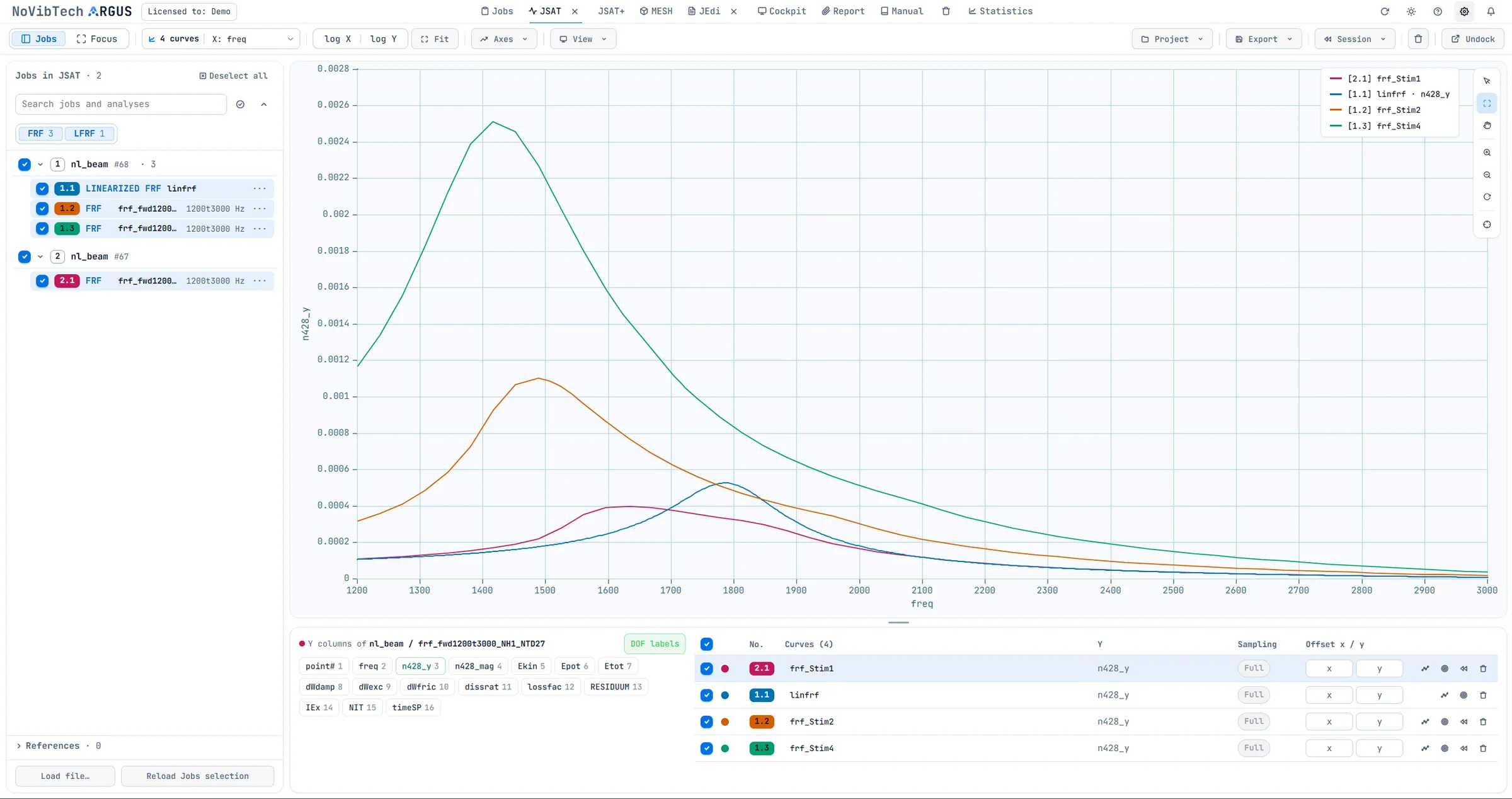
The solver handles the numerics. In ARGUS, you edit the input, keep track of runs and keep working with the results, all the way to an animated mode shape.
Next step
Let’s discuss your model, nonlinearities and the results you need. Together we define a meaningful evaluation case.
 ARGUS · JSAT